Blaue reiter bedeutung in der kunst
Ihre Betonung der spirituellen und emotionalen Dimensionen der Kunst veränderte den Kurs der modernen Kunst.
Wovon handeln die Gemälde des Blauen Reiters?
Die Gemälde des Blauen Reiters drehen sich hauptsächlich um die Befreiung von der gegenständlichen Kunst. Though the Bauhaus would pursue different goals (and eventually, a more streamlined design aesthetic), Feininger was among several Der Blaue Reiter members who wound up teaching at the groundbreaking institution.
Indeed, the members of Der Blaue Reiter were well connected to the experiments of Cubism in France, Futurism in Italy and Russia, and a plethora of other splinter movements in Europe. The poet Rainer Maria Rilke once wrote of Klee, "Even if you didn't tell me he plays the violin, I would have guessed on many occasions that his drawings were transcriptions of music." The contents of the Der Blaue Reiter Almanach demonstrate the group's commitment to musical form: a reproduction of one of Schönberg's songs, two others by his colleagues Alban Berg and Anton Webern, and an essay on "Anarchy in Music" by the Russian composer Thomas Alexandrovich de Hartmann.
For Kandinsky, the synesthetic relationship between color and sound could even be codified.
His mixed, subdued palette contrasts with the brightly primary colored canvases common to his prewar Blaue Reiter colleagues, and his looming background figures are visually more akin to the alienated men and women in Ernst Ludwig Kirchner's expressionistic street scenes or to Munch's The Scream. Jahrhundert war München ein Schmelztiegel kultureller Begeisterung und bot die perfekte Kulisse für eine künstlerische Revolution.
In 1924 while Kandinsky, Feininger, and Klee were together in Weimar, the painter and art dealer Emmy Scheyer brought Jawlensky back into their midst to form the exhibition group Der Blaue Vier (the Blue Four), promoting their art as an ensemble for the next decade.
Through the influence of Scheyer's exhibitions, the popularity of Klee and Kandinsky's art, and the immigration of the Bauhaus-taught painter and educator Josef Albers to the United States in 1933, the artists of Der Blaue Reiter also left a strong imprint on the development on Abstract Expressionism - perhaps most notably in the work of Jackson Pollock, Arshile Gorky, and Mark Rothko.
Dezember 1866
Oil on canvas - The Solomon R.
Guggenheim Museum, New York, New York
1913
Composition VII
Artist: Wassily Kandinsky
Widely considered Kandinsky's prewar masterpiece, Composition VII was, at the least, the mostly highly worked canvas he achieved with Der Blaue Reiter. It exchanges recognizable imagery for a balanced geometric composition of circles, rectangles, and irregular polygons delicately colored in a variety of mixed hues.
Watercolor and pencil on paper - Paul Klee Foundation, Kunstmuseen Bern, Switzerland
1914
Farewell
Artist: August Macke
Painted after the outbreak of WWI and the subsequent dissolution of Der Blaue Reiter, Macke's Farewell reflects the darker mood that overtook many European modern artists.
Seine Mitglieder trugen maßgeblich dazu bei, die Abstraktion voranzutreiben und ebneten den Weg für die Entwicklung der ungegenständlichen Kunst. In addition, the language of sound and music lent a vibrancy and descriptive power to abstract art: painted compositions could be loud and cacophonous or quiet and harmonious; a pigmented form could crescendo across a canvas, or a pairing of hues could create a visual vibrato.
In addition, several of the members of Der Blaue Reiter had direct relationships to music.
Für die Künstler des Blauen Reiters war Kunst nicht nur ein ästhetisches Streben, sondern eine mystische Reise in die menschliche Psyche.
Landschaft mit Fabrikschornstein (1910) von Wassily Kandinsky; Wassily Kandinsky, Public domain, via Wikimedia Commons
Der Glaube an das spirituelle Potenzial der Kunst beruhte auf der Vorstellung, dass visuelle Elemente wie Farbe, Form und Abstraktion Gefühle und Gedanken hervorrufen können, die über die greifbare Welt hinausgehen.
Befreiung von der Repräsentation
Um ihre spirituellen Ziele zu erreichen, mussten sich die Künstler des Blauen Reiters von den Zwängen der traditionellen Darstellung und des Realismus befreien.
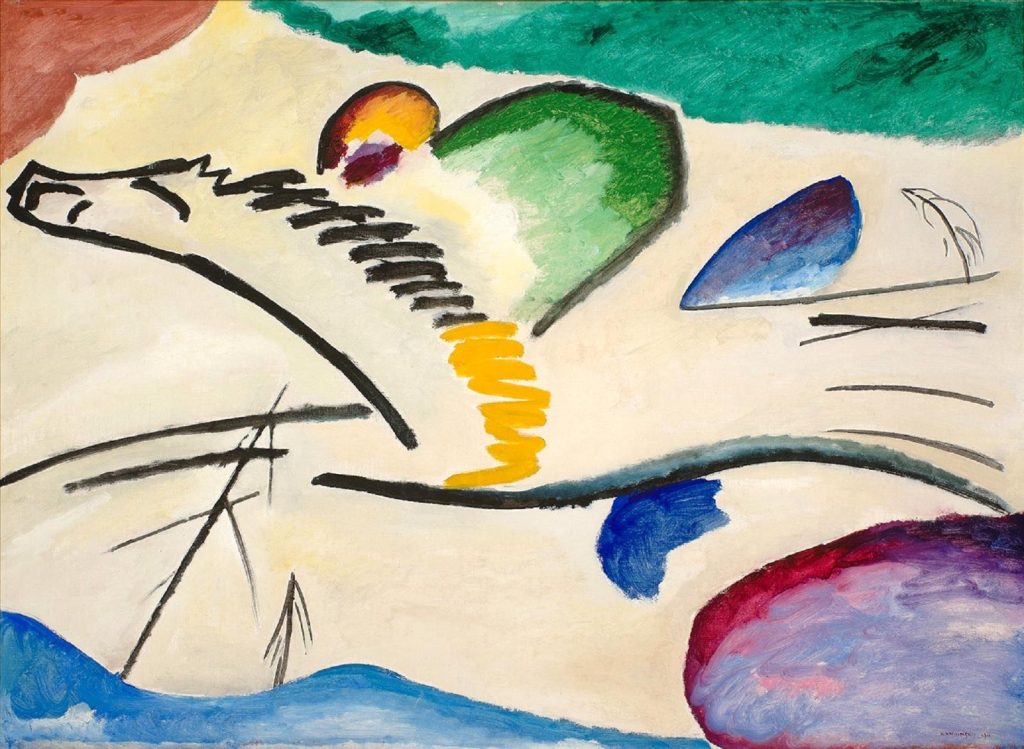
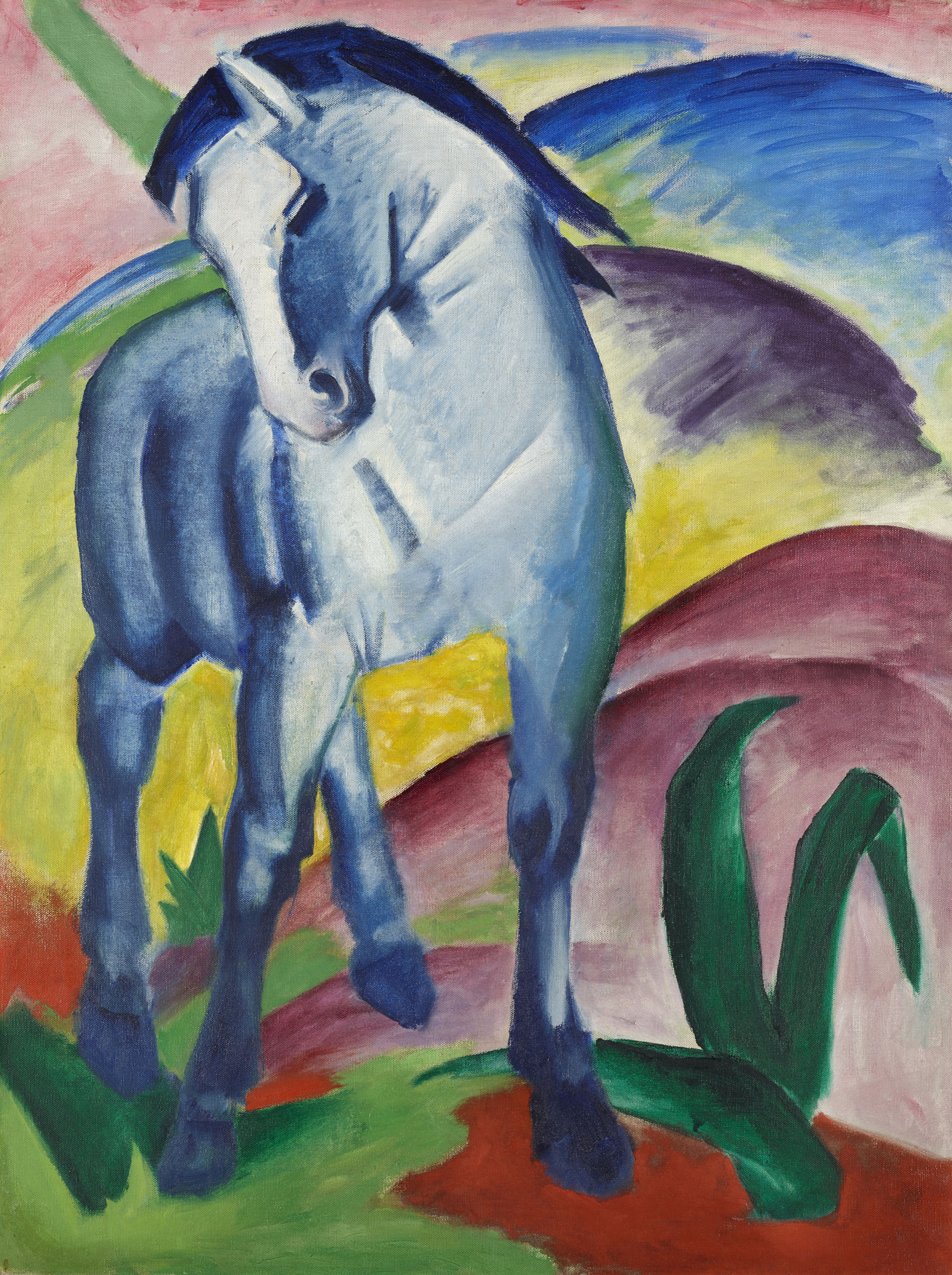
The name "Der Blaue Reiter" referred to Kandinsky and Marc's belief that blue was the most spiritual color and that the rider symbolized the ability to move beyond.
While both confronted feelings of alienation within an increasingly modernizing world, Der Blaue Reiter sought to transcend the mundane by pursuing the spiritual value of art. Dieser Artikel wirft einen tiefgehenden Blick auf diese avantgardistische Gruppe, die Anfang des 20. Moreover, Kandinsky suggested that hues of varying saturation corresponded to the timbres of specific instruments, where red was the strong, forceful playing of a trumpet fanfare or a high, clear violin, and green was a gentle violin played at middle position.
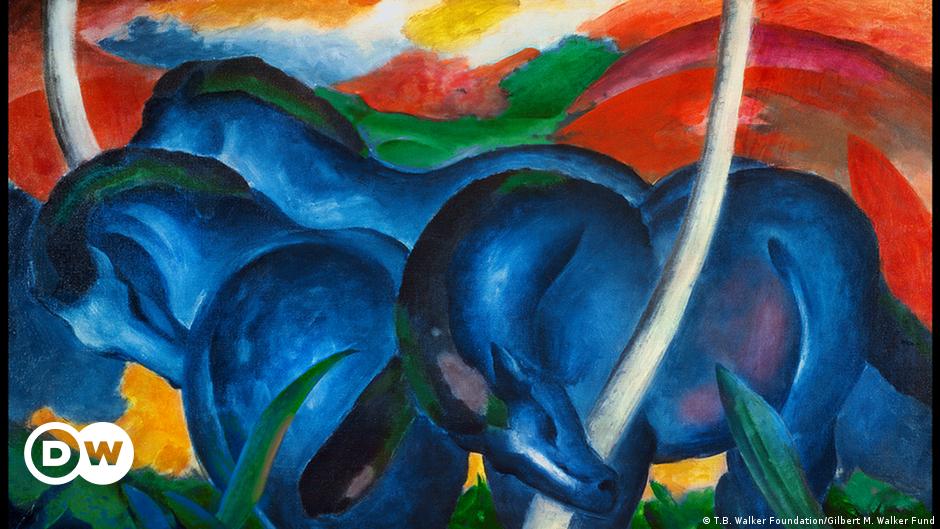
Das erste auffällige Merkmal der Komposition VII ist die lebendige und dynamische Verwendung von Farben. For example, in Marc's woodcuts and paintings - predominantly semi-figural paintings of animals in nature - the color yellow stood for feminine joy, while blue represented masculinity and (like Kandinsky) spirituality.
Auf der zweiten Ausstellung, Februar/ März 1912, in der „Münchner Buch- und Kunsthandlung Hans Goltz“, stellen insgesamt 30 Künstler rund 350 Werke aus. Painted in an early, Symbolist style, the painting nonetheless marked a turning point for the artist, where he began rendering his forms and colors with less distinct boundaries. Diese Merkmale spiegeln sich in Kandinskys Gemälden wider, die oft als die ersten abstrakten Werke der Kunstgeschichte angesehen werden.
Der Einfluss des Blauen Reiters auf die moderne Kunst
Der Blaue Reiter übte einen enormen Einfluss auf die Entwicklung der modernen Kunst aus.
Painted with a violence absent from his other major works, The Fate of the Animals has been read as a premonition of the war to come, with a conflagration destroying the animals' forest home. However, when Kandinsky painted that early canvas, perhaps indebted more to Gustav Klimt or Les Nabis, he had not yet developed the theory of color symbolism he would publish in Concerning the Spiritual in Art.
Ihr Vermächtnis zeugt von der bleibenden Kraft der Kunst, Konventionen in Frage zu stellen, Perspektiven zu verändern und den Betrachter auf eine tiefe spirituelle und emotionale Reise zu führen.
Häufig gestellte Fragen
Warum war der Blaue Reiter wichtig?
Der Blaue Reiter, angeführt von Künstlern wie Wassily Kandinsky und Franz Marc, markierte einen Schlüsselmoment in der Kunstgeschichte.
The widespread destruction of World War I (1914-18) struck many artists and intellectuals as a literal apocalypse, and Kandinsky would later respond by removing all recognizable imagery - especially representations of violent conflict - from his painting.
Oil on canvas - State Tretyakov Gallery, Moscow
1913
The Fate of the Animals
Artist: Franz Marc
Though Der Blaue Reiter developed its own lineage of Symbolist and Post-Impressionist painters, it belonged to an international avant-garde from which it adopted a range of modern styles.
Dasselbe Bild wird für die Titel-Illustration, des von Marc und Kandinsky herausgegebenen Almanach, „Die Blauen Reiter“ von 1912 verwendet. Die Künstler waren für ihren kühnen und ausdrucksstarken Einsatz von Farbe bekannt. Dieses Almanach wird zu einem der wichtigsten Künstlermanifeste, der modernen Kunst Europas.
Das Ziel „Der Blaue Reiter“ ist, mit den alten Maltraditionen der Akademien zu brechen, eine Plattform für eine „Neue Kunst“ zu erschaffen und neue künstlerische Ausdrucksformen zu erschaffen.

If Picasso and Braque were simplifying their palettes to grays and browns to better focus on issues of form, Der Blaue Reiter artists were heightening their use of color and theorizing its symbolic qualities. Kandinsky's suggestion that there were connections between visual components such as form, color, and movement and extra visual elements such as music, emotion, and thought provided the impetus for generations of avant-garde experimentation.
New Members, New Beginnings, and a New Name
The NKvM group mounted three traveling exhibitions during its three-year tenure, through which it accomplished two things.
First, it garnered recognition from avant-garde movements outside of Germany, including contributions by Georges Braque, Pablo Picasso, and André Derain, among others. This internationalism led the group to mount several traveling exhibitions during their brief tenure, making them an indispensable force in the promotion of early avant-garde painting.
Key Ideas & Accomplishments
- Though Der Blaue Reiter had no official manifesto, Kandinsky's treatise Concerning the Spiritual in Art (1910) laid out several of its guiding principles.
The choice of the semi-abstract "blue rider," with the color blue symbolizing intense spirituality and the rider symbolizing transcendent mobility, makes Kandinsky's print into a visual manifesto of his key concepts. This is because, despite the colonial underpinnings that allowed European artists to know of non-Western cultures, its use in the arts constituted a genuine attempt on the behalf of modern artists to break through the intellectual constraints of modern Western society by reaching to a "simpler," potentially "freer" means of expression in less-developed parts of the world.
Seine Reise nahm jedoch eine entscheidende Wendung, als er die pulsierende Kunstszene von München und Paris kennenlernte. Many intellectuals, Marc included, saw the forthcoming war as a chance for spiritual renewal.